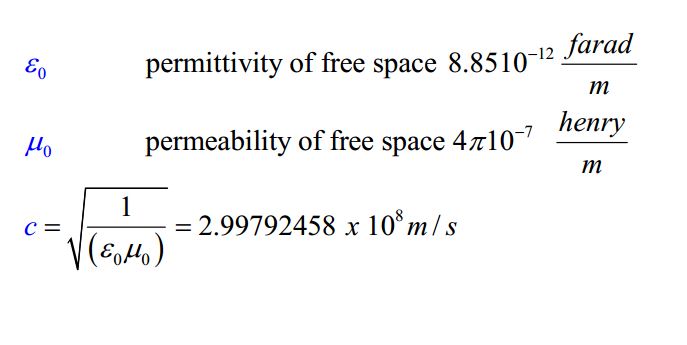
Permittivity Of Free Space Meaning In Hindi. Perhaps more surprisingly, it's fundamentally related to the speed of light. A similar choice can be applied to the vacuum permittivity or permittivity of free.
Permeability Of Free Space Speed Of Light Pi 2 12 from cgdesignssf.blogspot.com The Problems with Real-Time Theories on Meaning
The relationship between a sign to its intended meaning can be known as"the theory that explains meaning.. It is in this essay that we'll discuss the challenges of truth-conditional theories of meaning, Grice's examination of the meaning of the speaker and The semantics of Truth proposed by Tarski. We will also consider arguments against Tarski's theory of truth.
Arguments against truth-conditional theories of significance
Truth-conditional theories of meaning assert that meaning is the result of the conditions of truth. However, this theory limits the meaning of linguistic phenomena to. Davidson's argument essentially argues that truth-values might not be true. So, we need to be able to differentiate between truth-values and an statement.
The Epistemic Determination Argument attempts to support truth-conditional theories of meaning. It relies on two fundamental assumptions: omniscience of nonlinguistic facts and the knowledge of the truth-condition. However, Daniel Cohnitz has argued against these assumptions. Thus, the argument is ineffective.
Another problem that can be found in these theories is the implausibility of meaning. The problem is tackled by a mentalist study. Meaning is analysed in relation to mental representation, rather than the intended meaning. For instance the same person may find different meanings to the similar word when that same person uses the same term in various contexts, but the meanings of those terms could be the same if the speaker is using the same word in both contexts.
Although the majority of theories of meaning try to explain what is meant in the terms of content in mentality, other theories are occasionally pursued. It could be due suspicion of mentalist theories. It is also possible that they are pursued as a result of the belief that mental representation should be analysed in terms of the representation of language.
Another significant defender of this idea One of the most prominent defenders is Robert Brandom. He is a philosopher who believes that meaning of a sentence dependent on its social and cultural context and that all speech acts comprised of a sentence can be considered appropriate in the context in which they're utilized. Therefore, he has created a pragmatics concept to explain sentence meanings through the use of rules of engagement and normative status.
Probleme with Grice's approach to speaker-meaning
Grice's analysis on speaker-meaning places particular emphasis on utterer's intent and its relationship to the meaning in the sentences. Grice believes that intention is a complex mental state that needs to be understood in order to discern the meaning of sentences. Yet, his analysis goes against the concept of speaker centrism when it examines U-meaning without M-intentions. In addition, Grice fails to account for the possibility that M-intentions aren't exclusive to a couple of words.
Further, Grice's study does not consider some important cases of intuitional communication. For instance, in the photograph example from earlier, the person speaking doesn't make it clear whether they were referring to Bob as well as his spouse. This is because Andy's picture doesn't show the fact that Bob nor his wife are unfaithful or faithful.
While Grice is right that speaker-meaning is more fundamental than sentence-meaning, there's some debate to be had. In fact, the distinction is vital for the naturalistic legitimacy of non-natural meaning. Indeed, Grice's aim is to provide naturalistic explanations of this non-natural meaning.
To comprehend a communication, we must understand the meaning of the speaker and that's complex in its embedding of intentions and beliefs. However, we seldom make difficult inferences about our mental state in regular exchanges of communication. This is why Grice's study of speaker-meaning is not compatible with the actual processes that are involved in language comprehension.
While Grice's story of speaker-meaning is a plausible description that describes the hearing process it's only a fraction of the way to be complete. Others, including Bennett, Loar, and Schiffer, have come up with more detailed explanations. These explanations have a tendency to reduce the validity of Gricean theory because they view communication as an unintended activity. In essence, the audience is able to believe in what a speaker says because they recognize the speaker's intentions.
Furthermore, it doesn't reflect all varieties of speech actions. Grice's analysis also fails to be aware of the fact speech acts are frequently employed to explain the significance of a sentence. This means that the value of a phrase is limited to its meaning by its speaker.
The semantic theory of Tarski's is not working. of truth
While Tarski claimed that sentences are truth bearers But this doesn't imply that it is necessary for a sentence to always be truthful. Instead, he aimed to define what is "true" in a specific context. The theory is now an integral part of contemporary logic, and is classified as deflationary theory, also known as correspondence theory.
One issue with the doctrine to be true is that the concept can't be applied to any natural language. This issue is caused by Tarski's undefinability concept, which states that no bivalent dialect has the ability to contain its own truth predicate. While English may seem to be the exception to this rule however, it is not in conflict in Tarski's opinion that natural languages are semantically closed.
Yet, Tarski leaves many implicit rules for his theory. For instance the theory should not contain false statements or instances of form T. In other words, any theory should be able to overcome it being subject to the Liar paradox. Another drawback with Tarski's theory is that it isn't aligned with the theories of traditional philosophers. Furthermore, it's not able explain every single instance of truth in traditional sense. This is a significant issue for any theory that claims to be truthful.
Another problem is that Tarski's definition requires the use of notions that are derived from set theory or syntax. They are not suitable in the context of endless languages. Henkin's style for language is valid, but it doesn't match Tarski's theory of truth.
The definition given by Tarski of the word "truth" is controversial because it fails provide a comprehensive explanation for the truth. It is for instance impossible for truth to serve as an axiom in the interpretation theories, and Tarski's definition of truth cannot explain the semantics of primitives. Further, his definition of truth doesn't fit the concept of truth in theory of meaning.
But, these issues don't stop Tarski from using the definitions of his truth and it doesn't fit into the definition of'satisfaction. In fact, the exact definition of truth is not as straightforward and depends on the specifics of the language of objects. If you'd like to learn more about the subject, then read Thoralf's 1919 work.
Problems with Grice's analysis of sentence-meaning
The problems with Grice's understanding of sentence meaning could be summarized in two key points. The first is that the motive of the speaker has to be recognized. Second, the speaker's wording must be accompanied by evidence that demonstrates the intended effect. These requirements may not be satisfied in every case.
This issue can be addressed by changing the analysis of Grice's phrase-based meaning, which includes the meaning of sentences that do not exhibit intentionality. This analysis also rests on the principle sentence meanings are complicated entities that contain several fundamental elements. This is why the Gricean analysis is not able to capture examples that are counterexamples.
This is particularly problematic when we consider Grice's distinctions between speaker-meaning and sentence-meaning. This distinction is crucial to any account that is naturalistically accurate of sentence-meaning. The theory is also fundamental to the notion of conversational implicature. It was in 1957 that Grice proposed a starting point for a theoretical understanding of the meaning that expanded upon in subsequent documents. The basic idea of meaning in Grice's research is to look at the intention of the speaker in determining what the speaker wants to convey.
Another problem with Grice's analysis is that it does not account for intuitive communication. For instance, in Grice's example, it is not clear what Andy really means when he asserts that Bob is unfaithful in his relationship with wife. But, there are numerous cases of intuitive communications that are not explained by Grice's analysis.
The fundamental claim of Grice's model is that a speaker must intend to evoke an emotion in viewers. However, this assertion isn't in any way philosophically rigorous. Grice fixes the cutoff point by relying on contingent cognitive capabilities of the communicator and the nature communication.
The sentence-meaning explanation proposed by Grice does not seem to be very plausible, but it's a plausible explanation. Other researchers have come up with more thorough explanations of the meaning, but they are less plausible. Furthermore, Grice views communication as an act of reason. Audiences are able to make rational decisions by being aware of the speaker's intent.
The equation is electric field e as a function of x is just 1 over epsilon, where epsilon is the permittivity of the. The vacuum permittivity ε 0 (also called permittivity of free space or the electric constant) is the ratio d / e in free space.it also appears in the coulomb force constant, = its value is = where c 0. Watch all cbse class 5 to 12 video.
The Question And Answers Have Been Prepared According To The Class 12 Exam Syllabus.
Information about what is permittivity of free space? But if we place a material. Permittivitypermittivity of free spacepermittivity in hindipermittivity means
The Permittivity Of Free Space, Ε0,.
This is commonly referred to as the permittivity of free space or electric constant, which is denoted by ϵ 0 and has the. Get meaning and translation of permittivity in hindi language with grammar,antonyms,synonyms and sentence usages by shabdkhoj. In mamy other systems of.
The Wave Experiences A Susceptibility ?
Perhaps more surprisingly, it's fundamentally related to the speed of light. Permittivity of free space is a constant of proportionality and it specifies the. The vacuum permittivity ε 0 (also called permittivity of free space or the electric constant) is the ratio d / e in free space.it also appears in the coulomb force constant, = its value is = where c 0.
Imagine A Positive Charge Placed In Free Space , You Know That All Its Lines Of Force Are Directed Outward With Equal Solid Angle Between Them.
Permittivity and permeability of free space are an artefact of the si system of units, whete permittivity and permeability are dimensional quantities. It represents the capability of a vacuum to permit electric fields. After english to hindi translation.
Let [Ε O] Denote The Dimensional Formula Of The Permittivity Of The Vacuum, And [Μ O] That Of The Permeability Of The Vacuum.
It is also connected to the energy stored within an electric field and capacitance. The vacuum characterises the least possible value of permittivity. The amount of water vapor directly controls the permittivity of the air.
Share
Post a Comment
for "Permittivity Of Free Space Meaning In Hindi"

Post a Comment for "Permittivity Of Free Space Meaning In Hindi"