Desperate Meaning In Hindi. Translation in hindi for desperate with similar and opposite words. To be filled with a sense of hopelessness, despondency, and despair because of a bad situation.
Learn Hindi From English Desperate Meaning in Hindi 3speak from 3speak.tv The Problems with True-Conditional theories about Meaning
The relationship between a symbol and its meaning is called"the theory on meaning. Here, we'll review the problems with truth-conditional theories on meaning, Grice's understanding of meanings given by the speaker, as well as that of Tarski's semantic theorem of truth. The article will also explore the arguments that Tarski's theory of truth.
Arguments against the truth-based theories of meaning
Truth-conditional theories for meaning say that meaning is a function of the conditions for truth. But, this theory restricts definition to the linguistic phenomena. This argument is essentially that truth-values can't be always accurate. This is why we must be able to differentiate between truth-values from a flat claim.
It is the Epistemic Determination Argument is an attempt to provide evidence for truth-conditional theories regarding meaning. It relies on two fundamental foundational assumptions: omniscience over nonlinguistic facts and understanding of the truth condition. However, Daniel Cohnitz has argued against these assumptions. Thus, the argument is ineffective.
A common issue with these theories is the incredibility of meaning. The problem is addressed by a mentalist analysis. This is where meaning can be examined in regards to a representation of the mental instead of the meaning intended. For example someone could see different meanings for the term when the same person uses the exact word in different circumstances, however, the meanings of these words may be the same even if the person is using the same phrase in at least two contexts.
Although the majority of theories of meaning attempt to explain concepts of meaning in terms of mental content, non-mentalist theories are sometimes explored. This may be due to an aversion to mentalist theories. These theories are also pursued by people who are of the opinion mental representations must be evaluated in terms of the representation of language.
A key defender of this view is Robert Brandom. He believes that the purpose of a statement is dependent on its social setting and that speech activities using a sentence are suitable in the context in where they're being used. So, he's developed a pragmatics theory that explains sentence meanings by using normative and social practices.
Probleme with Grice's approach to speaker-meaning
Grice's analysis of speaker-meaning puts particular emphasis on utterer's intention and how it relates to the significance in the sentences. The author argues that intent is an intricate mental state which must be considered in order to determine the meaning of sentences. However, this interpretation is contrary to the principle of speaker centrism, which is to analyze U-meaning without M-intentions. In addition, Grice fails to account for the possibility that M-intentions aren't exclusive to a couple of words.
Further, Grice's study doesn't account for important instances of intuitive communication. For instance, in the photograph example previously mentioned, the speaker isn't clear as to whether the subject was Bob himself or his wife. This is problematic because Andy's picture does not indicate the fact that Bob as well as his spouse are unfaithful or faithful.
Although Grice is right that speaker-meaning has more significance than sentence-meanings, there is some debate to be had. The distinction is crucial for the naturalistic respectability of non-natural meaning. Indeed, Grice's goal is to present naturalistic explanations and explanations for these non-natural significance.
To understand a message you must know that the speaker's intent, as that intention is a complex embedding of intentions and beliefs. We rarely draw difficult inferences about our mental state in everyday conversations. This is why Grice's study of meaning of the speaker is not compatible with the real psychological processes involved in language comprehension.
While Grice's account of speaker-meaning is a plausible description of this process it is still far from complete. Others, such as Bennett, Loar, and Schiffer, have come up with more detailed explanations. However, these explanations have a tendency to reduce the validity of the Gricean theory since they treat communication as an act of rationality. In essence, the audience is able to be convinced that the speaker's message is true because they understand the speaker's intention.
It also fails to take into account all kinds of speech actions. The analysis of Grice fails to take into account the fact that speech acts can be used to explain the meaning of sentences. The result is that the significance of a sentence is reduced to the meaning of the speaker.
Problems with Tarski's semantic theories of truth
While Tarski said that sentences are truth-bearing But this doesn't imply that any sentence is always true. Instead, he aimed to define what is "true" in a specific context. The theory is now the basis of modern logic and is classified as deflationary or correspondence theory.
One problem with the theory of truth is that this theory cannot be applied to any natural language. This is because of Tarski's undefinability hypothesis, which states that no language that is bivalent could contain its own predicate. Although English may appear to be an one exception to this law, this does not conflict with Tarski's theory that natural languages are closed semantically.
Yet, Tarski leaves many implicit restrictions on his theory. For example it is not allowed for a theory to contain false sentences or instances of form T. In other words, a theory must avoid being a victim of the Liar paradox. Another problem with Tarski's theory is that it is not consistent with the work of traditional philosophers. Additionally, it's not able to explain every single instance of truth in terms of normal sense. This is an issue in any theory of truth.
The other issue is that Tarski's definitions of truth calls for the use of concepts taken from syntax and set theory. These aren't suitable when looking at endless languages. The style of language used by Henkin is well-founded, however it doesn't fit Tarski's concept of truth.
Tarski's definition of truth is difficult to comprehend because it doesn't take into account the complexity of the truth. For instance, truth can't play the role of an axiom in language theory and Tarski's definition of truth cannot clarify the meaning of primitives. Additionally, his definition of truth isn't in accordance with the notion of truth in sense theories.
However, these challenges should not hinder Tarski from applying the truth definition he gives and it does not fall into the'satisfaction' definition. Actually, the actual definition of truth isn't as than simple and is dependent on the specifics of object language. If you're interested in learning more, check out Thoralf Skolem's 1919 paper.
A few issues with Grice's analysis on sentence-meaning
The problems with Grice's analysis of the meaning of sentences can be summed up in two key points. The first is that the motive of the speaker must be understood. Second, the speaker's utterance is to be supported by evidence that brings about the desired effect. However, these conditions aren't fully met in every case.
This problem can be solved by changing Grice's analysis of sentence meaning to consider the meaning of sentences that do not exhibit intention. The analysis is based upon the assumption that sentences are complex entities that contain a variety of fundamental elements. This is why the Gricean analysis fails to recognize counterexamples.
This is particularly problematic with regard to Grice's distinctions between meaning of the speaker and sentence. This distinction is crucial to any naturalistically respectable account of the meaning of a sentence. This theory is also vital to the notion of implicature in conversation. As early as 1957 Grice proposed a starting point for a theoretical understanding of the meaning, which was elaborated in subsequent works. The fundamental idea behind the concept of meaning in Grice's work is to examine the speaker's motives in determining what message the speaker is trying to communicate.
Another issue with Grice's approach is that it fails to take into account intuitive communication. For example, in Grice's example, it's not entirely clear what Andy believes when he states that Bob is unfaithful to his wife. However, there are a lot of variations of intuitive communication which do not fit into Grice's study.
The basic premise of Grice's study is that the speaker must aim to provoke an emotion in an audience. However, this argument isn't intellectually rigorous. Grice fixes the cutoff point using contingent cognitive capabilities of the interlocutor , as well as the nature and nature of communication.
The sentence-meaning explanation proposed by Grice isn't particularly plausible, though it is a plausible theory. Other researchers have developed more in-depth explanations of meaning, however, they appear less plausible. In addition, Grice views communication as the activity of rationality. Audiences reason to their beliefs by observing an individual's intention.
Know answer of question :. Get the meaning of desperate in hindi with usage, synonyms, antonyms & pronunciation. He looked around at the.
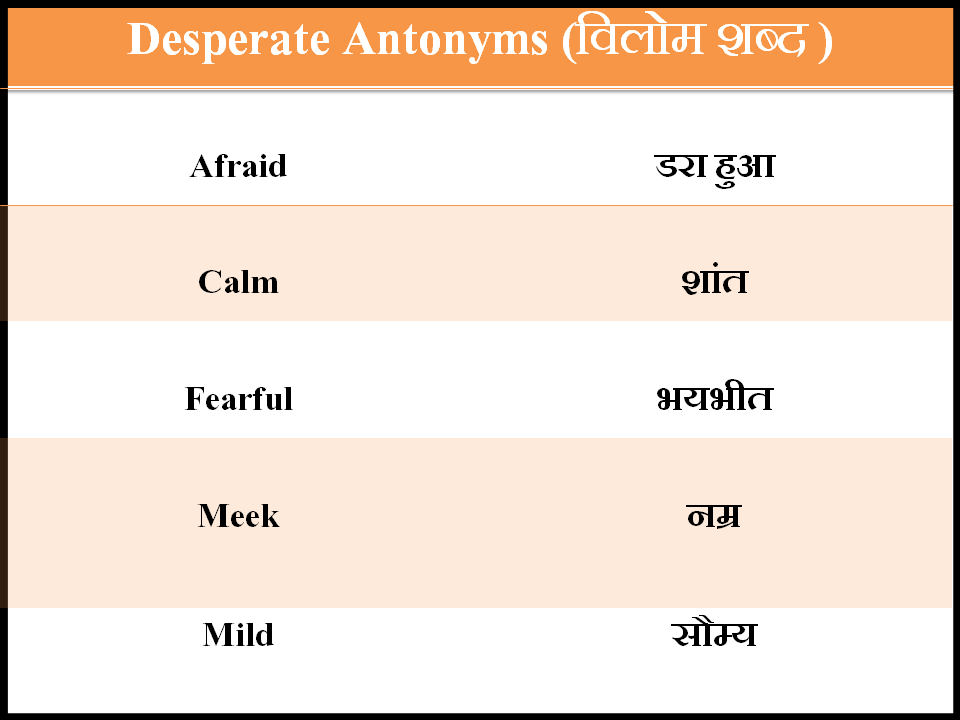
Definitions And Meaning Of Desperate In Hindi, Translation Of Desperate In Hindi Language With Similar And Opposite Words.
It worked and those who benefited from kickbacks earlier are desperate. Hindi words for desperate include मायूस, निराश, निराशाजनक, अंधाधुंध, बेअक़ल, बेधड़क, अति भयंकर, निराशान्ध, मरने पर उतारू and दुस्साहसिक. Looking for the meaning of desperate in hindi?
Needing Or Wanting Something Very Much:
An extremely strong desire to recover. Get the meaning of desperate in hindi with usage, synonyms, antonyms & pronunciation. Sentence usage examples & english to hindi translation (word meaning).
Find More Hindi Words At Wordhippo.com!
Desperate (adj) = arising from or marked by despair or. शुरू में जिन लगों को दलली से लभ हा था वे परेशान हैं. Desperate definition, pronuniation, antonyms, synonyms and example sentences in hindi.
इस लेख में अंग्रेजी शब्द ‘Desperate’ का मतलब आसान हिंदी में उदाहरण (Example) सहित दिया गया है और साथ में दिए गए है
Desperate meaning in hindi : Translation in hindi for desperate with similar and opposite words. To be filled with a sense of hopelessness, despondency, and despair because of a bad situation.
Website For Synonyms, Antonyms, Verb Conjugations And Translations.
Get meaning and translation of desperate in hindi language with grammar,antonyms,synonyms and sentence usages by shabdkhoj. They prey on the hopes of the desperate. He looked around at the.

Post a Comment for "Desperate Meaning In Hindi"