Psalm 147 4 Meaning. Ps 147:3 he heals the brokenhearted, and binds up their wounds. He is able, he is able, i know my lord is able, i know my lord is able to.
Daily Bible Verse for August 18 Psalm 1474 Daily Devotional from besharpened.com The Problems with Truth-Conditional Theories of Meaning
The relationship between a sign and the meaning of its sign is called"the theory that explains meaning.. Here, we'll discuss the challenges of truth-conditional theories of meaning. We will also discuss Grice's analysis of speaker-meaning, and his semantic theory of truth. We will also discuss theories that contradict Tarski's theory about truth.
Arguments against truth-conditional theories of meaning
Truth-conditional theories of understanding claim that meaning is a function of the elements of truth. This theory, however, limits meaning to the phenomena of language. A Davidson argument basically argues that truth-values are not always accurate. Therefore, we should know the difference between truth and flat statement.
The Epistemic Determination Argument is a method to provide evidence for truth-conditional theories regarding meaning. It relies upon two fundamental assumptions: the existence of all non-linguistic facts and the understanding of the truth-condition. However, Daniel Cohnitz has argued against these premises. Thus, the argument doesn't have merit.
Another common concern with these theories is the incredibility of the concept of. However, this concern is addressed through mentalist analysis. In this method, meaning is considered in relation to mental representation instead of the meaning intended. For example the same person may have different meanings of the same word if the same person uses the exact word in several different settings, however, the meanings for those words could be similar when the speaker uses the same word in 2 different situations.
Although the majority of theories of meaning attempt to explain meaning in relation to the content of mind, other theories are sometimes explored. This could be due to doubt about the validity of mentalist theories. These theories are also pursued as a result of the belief that mental representation needs to be examined in terms of linguistic representation.
Another significant defender of this idea A further defender Robert Brandom. This philosopher believes that the meaning of a sentence dependent on its social setting, and that speech acts using a sentence are suitable in an environment in the setting in which they're used. Therefore, he has created a pragmatics model to explain the meanings of sentences based on social practices and normative statuses.
Grice's analysis of speaker-meaning
Grice's analysis based on speaker-meaning puts much emphasis on the utterer's intention and how it relates to the significance of the phrase. He believes that intention is an intricate mental state which must be considered in order to determine the meaning of sentences. Yet, this analysis violates speaker centrism by analyzing U-meaning without M-intentions. Furthermore, Grice fails to account for the nature of M-intentions that aren't specific to one or two.
In addition, the analysis of Grice doesn't take into consideration some critical instances of intuitive communication. For instance, in the photograph example from earlier, the speaker cannot be clear on whether she was talking about Bob or to his wife. This is an issue because Andy's picture does not indicate whether Bob himself or the wife is unfaithful , or faithful.
Although Grice is correct the speaker's meaning is more fundamental than sentence-meaning, there's some debate to be had. In fact, the distinction is crucial for the naturalistic respectability of non-natural meaning. In the end, Grice's mission is to offer naturalistic explanations for such non-natural significance.
To understand a message you must know the speaker's intention, and this is an intricate embedding of intents and beliefs. But, we seldom draw sophisticated inferences about mental states in simple exchanges. So, Grice's understanding of meaning of the speaker is not compatible with the real psychological processes involved in communication.
Although Grice's explanation of speaker-meaning is a plausible explanation for the process it's still far from complete. Others, such as Bennett, Loar, and Schiffer, have come up with more detailed explanations. These explanations have a tendency to reduce the validity for the Gricean theory because they see communication as an act of rationality. The reason audiences accept what the speaker is saying due to the fact that they understand the speaker's purpose.
In addition, it fails to take into account all kinds of speech acts. Grice's model also fails include the fact speech actions are often employed to explain the meaning of a sentence. In the end, the purpose of a sentence gets diminished to the meaning given by the speaker.
Problems with Tarski's semantic theory of truth
While Tarski believed that sentences are truth-bearing It doesn't necessarily mean that a sentence must always be correct. Instead, he sought to define what is "true" in a specific context. His theory has become an integral part of contemporary logic, and is classified as correspondence or deflationary.
One problem with this theory for truth is it cannot be applied to natural languages. This is due to Tarski's undefinabilitytheorem, which states that no bivalent dialect is able to have its own truth predicate. Even though English could be seen as an one exception to this law but it does not go along with Tarski's view that natural languages are closed semantically.
Yet, Tarski leaves many implicit limitations on his theory. For example it is not allowed for a theory to contain false sentences or instances of the form T. This means that it must avoid any Liar paradox. Another issue with Tarski's theory is that it is not aligned with the theories of traditional philosophers. Furthermore, it's unable to describe every instance of truth in terms of normal sense. This is a major problem for any theories of truth.
The other issue is the fact that Tarski's definitions of truth is based on notions from set theory and syntax. These are not appropriate for a discussion of endless languages. Henkin's style of speaking is valid, but it doesn't match Tarski's concept of truth.
Tarski's definition of truth is controversial because it fails reflect the complexity of the truth. Truth, for instance, cannot play the role of an axiom in an understanding theory the axioms of Tarski's theory cannot describe the semantics of primitives. Furthermore, his definition for truth is not consistent with the concept of truth in terms of meaning theories.
However, these issues do not mean that Tarski is not capable of using Tarski's definition of what is truth and it does not be a part of the'satisfaction' definition. The actual definition of truth is less easy to define and relies on the particularities of the object language. If you're looking to know more about it, read Thoralf's 1919 work.
A few issues with Grice's analysis on sentence-meaning
The problems that Grice's analysis has with its analysis on sentence meaning can be summarized in two main points. First, the intention of the speaker has to be recognized. In addition, the speech must be accompanied by evidence that supports the intended result. However, these criteria aren't in all cases. in all cases.
This problem can be solved by changing the analysis of Grice's meanings of sentences in order to take into account the meaning of sentences which do not possess intentionality. This analysis is also based on the premise that sentences are highly complex entities that contain a variety of fundamental elements. Thus, the Gricean analysis does not capture examples that are counterexamples.
This criticism is particularly problematic when considering Grice's distinction between speaker-meaning and sentence-meaning. This distinction is essential to any naturalistically based account of sentence-meaning. This theory is also crucial in the theory of conversational implicature. In 1957, Grice provided a basic theory of meaning, which was elaborated in subsequent research papers. The idea of significance in Grice's work is to consider the speaker's motives in determining what message the speaker is trying to communicate.
Another issue with Grice's analysis is that it doesn't allow for intuitive communication. For example, in Grice's example, it is not clear what Andy is referring to when he says that Bob is not faithful for his wife. Yet, there are many other examples of intuitive communication that do not fit into Grice's research.
The main premise of Grice's approach is that a speaker has to be intending to create an emotion in an audience. But this isn't rationally rigorous. Grice adjusts the cutoff on the basis of potential cognitive capacities of the interlocutor , as well as the nature and nature of communication.
The sentence-meaning explanation proposed by Grice isn't particularly plausible, though it's a plausible theory. Different researchers have produced more elaborate explanations of meaning, but they're less plausible. Furthermore, Grice views communication as a rational activity. Audiences are able to make rational decisions by being aware of their speaker's motives.
God let the babylonians beat his people that lived near jerusalem. For example, “the lord lifts up the downtrodden; And calls them each by name.
5 Great Is Our Lord And Mighty In Power;
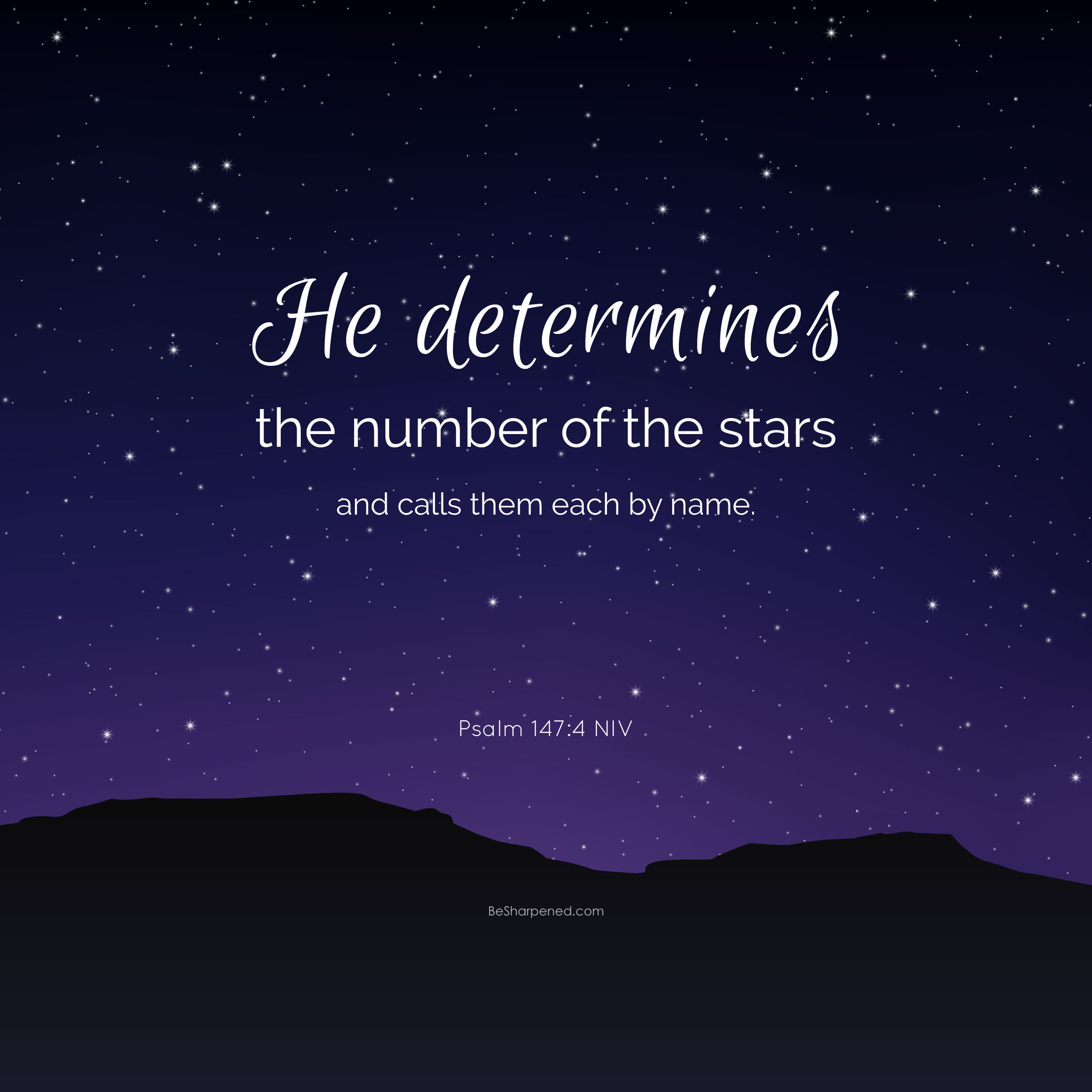
He tells the number of the stars; He has sent me to bring good. 3 he heals the brokenhearted and binds up their wounds.
Psalm 147 Is The 147Th Psalm Of The Book Of Psalms, Beginning In English In The King James Version, Praise Ye The L Ord:
For it is good to sing praises unto our god; He determines the number of the stars and calls them each by name. The final psalm forms a climax to the whole book.
He Casts The Wicked To The Ground” (147:6).
Praise him, all ye stars of light. And calls them each by name. He is able, he is able, i know my lord is able, i know my lord is able to.
For Example, “The Lord Lifts Up The Downtrodden;
What does this verse really mean? 6 the lord sustains the humble. He determines the number of the.
He Calls Them All By Their Names.
For it is good to sing praises.in the slightly different numbering. 5 great is our lord and mighty in power; The whole psalm is an invitation unto praising of god.

Post a Comment for "Psalm 147 4 Meaning"